
Brain implants for severe OCD are getting personal, and the early results suggest the map matters more than the coordinates

Updated: Aug 4
News Analysis
For two decades surgeons aimed at roughly the same deep brain structures in every patient. A handful of small studies now suggest the best spot differs from person to person, and that finding it individually may work better.
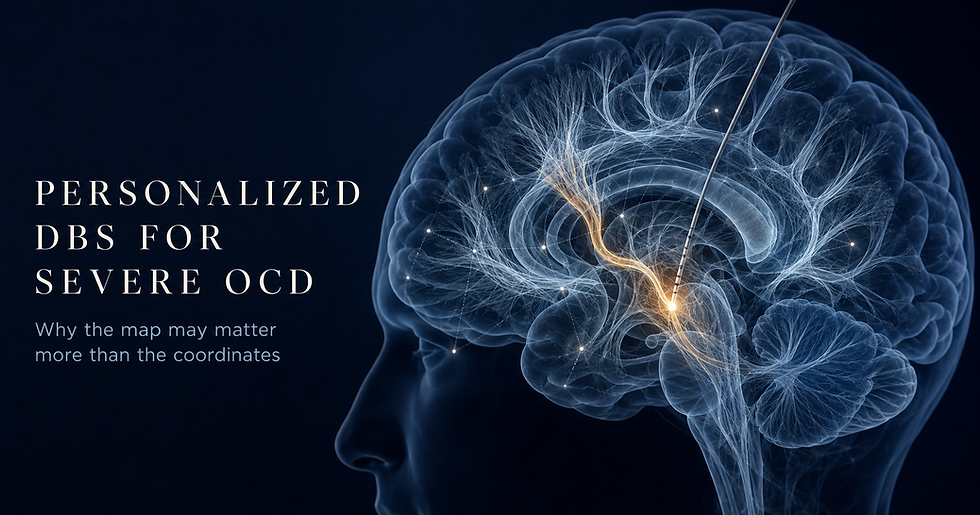
Doctors spent several days inside one patient's brain before deciding where the permanent electrodes should go. Using temporary recording wires threaded across the circuit implicated in obsessive-compulsive disorder, they stimulated site after site while watching what happened to symptoms in real time. Two spots in the right ventral capsule stood out. Stimulating them relieved symptoms quickly and suppressed high-frequency activity in the orbitofrontal cortex, a signal that tracked how severe the patient's symptoms were. Those two spots became the targets. Six months later, symptoms had fallen by roughly 62 percent.
The case involves exactly one person, which is worth saying before anything else. But it has been described as the first clear proof of concept that invasive brain mapping can guide personalized, multi-site deep brain stimulation for OCD, and it lands alongside two other small studies pointing in the same direction. Taken together they suggest something that sounds obvious in hindsight and has taken years to demonstrate: where you put the electrode may matter less than whether you chose that location for the specific brain in front of you.
What the surgery actually does
Deep brain stimulation, or DBS, means implanting electrodes into deep brain regions and running continuous electrical current through them from a pulse generator placed under the skin. In OCD the target regions sit within what researchers call the cortico-striato-thalamo-cortical circuit, a loop that runs between the frontal cortex and structures buried near the center of the brain. Traditional targets include the anterior limb of the internal capsule, the nucleus accumbens, the bed nucleus of the stria terminalis, and the ventral capsule and ventral striatum. All of these are tangled up in anxiety, motivation, and the machinery of habit.
The procedure is not a first-line treatment or a tenth-line one. It is reserved for people with severe, chronic OCD who have already worked through multiple medications and intensive cognitive behavioral therapy, usually including exposure and response prevention.
For that population the results have been genuinely good. Across studies and meta-analyses, somewhere between 60 and 70 percent of carefully selected patients show a clinically meaningful response, defined as at least a 35 percent drop on the Yale-Brown Obsessive-Compulsive Scale. Pooled data suggest average reductions in the range of 45 to 48 percent, and some larger prospective studies report mean reductions of about 40 to 47 percent with 60 percent of patients meeting response criteria at twelve months.
The problem hiding inside those numbers
Good average results conceal a real difficulty. Outcomes have varied considerably from patient to patient, and no single anatomical target has emerged as best for everyone. Surgeons have largely worked from standard stereotactic coordinates, the same map applied to different brains.
Three recent efforts have tried to replace that fixed map with an individual one.
The invasive mapping case described above is the most aggressive version. Stereo-EEG electrodes were placed across the patient's own OCD circuit during a multi-day inpatient period, and the team probed many sites while monitoring both symptoms and neural activity before committing to a permanent implant.
A second approach uses diffusion MRI to trace each patient's white matter connections and find what researchers have called a connectivity sweet spot. In one study of ten patients receiving stimulation in the anterior limb of the internal capsule, the team identified the site in each brain that best connected to ventromedial and orbitofrontal cortex, ventrolateral prefrontal cortex, and midbrain regions implicated in OCD. Eight of the ten reached at least 35 percent improvement, and the researchers reported consistent symptom reduction with little need to adjust stimulation settings afterward.
A third study combined symptom-provocation functional MRI with tractography to decide whether an individual patient's optimal site leaned toward the caudate or toward the nucleus accumbens. Six patients showed a median 50 percent symptom reduction from their best contact. The relevant finding was not the number. It was that the best target genuinely differed between people.
What this does not yet establish
Ten patients. Six patients. One patient. These are the sample sizes carrying the argument, and none of the studies described here appears to include a control group receiving standard targeting for comparison. The follow-up windows run six to twelve months, which tells us little about durability over the years a permanent implant is meant to last.
There is also a plausible alternative reading. Patients selected for elaborate multi-day mapping protocols may differ systematically from ordinary surgical candidates, and more attentive individualized programming afterward could account for part of the benefit independent of where the electrode sits.
The speed of response is the most suggestive detail. Classic DBS trials show improvement unfolding over weeks to months as programming is optimized and patients adapt. In the mapping case, stimulation of the individually identified targets produced relief acutely in the lab and a large reduction within the first months. Better aim may not only improve response but accelerate it. That remains a hypothesis.
Risk, access, and the part therapists are watching
This is still neurosurgery. In a thirty-patient multicenter study of stimulation in the anterior limb of the internal capsule, every patient experienced some adverse event. Most were mild or moderate and transient, frequently tied to stimulation settings. Serious events included transient anxiety or affective worsening, infections, and rare seizures. Systematic reviews conclude the benefits generally outweigh the risks in this specific population while stressing careful selection, long-term follow-up, and continued medication and psychotherapy alongside the device.
Access is uneven. Regulatory status varies by country, and in many places DBS for OCD remains an advanced or experimental therapy available only at specialized centers or under research protocols.
One clinical observation may end up mattering more than the imaging. Early reports suggest that when stimulation reduces the raw drive behind obsessions and compulsions, patients become more able to engage in exposure and response prevention work they previously could not tolerate. If that holds, the device is less a replacement for therapy than a way of making therapy possible. The interaction has not been systematically studied yet.
What would settle the question is straightforward to describe and slow to produce: a controlled trial comparing individually mapped targets against standard coordinates in the same patient population, with follow-up measured in years rather than months. Until then, the honest summary is that personalized targeting looks promising in a small number of people who had run out of other options.
Reporting Note: This article is based on a supplied research summary on DBS for treatment-resistant OCD and two bullet points on precision psychiatry referencing a June 2026 Harvard Gazette report. The provided material did not include study names, institutions, authors, funding sources, publication venues, patient demographics, or cost and coverage information, and did not indicate whether any of the personalization studies included control groups. The transcranial magnetic stimulation finding referenced in the supplied notes is summarized too briefly to report on here and has been left out. No outside research was added.


Comments